
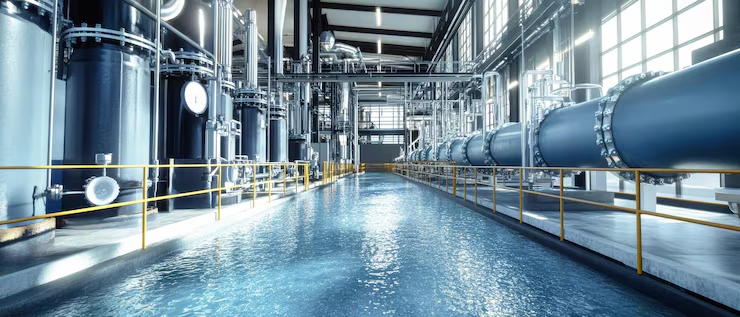
Wastewater Reuse, RO Efficiency & Sustainability: The Future of Building Water Systems
Water Is No Longer a Utility — It Is Strategic Infrastructure
For decades, buildings were designed around a simple water assumption: clean water comes in, wastewater goes out. This linear mindset shaped plumbing layouts, equipment sizing, and operational practices across residential, commercial, and industrial developments.
That model no longer works.
In today’s environment—marked by rising water scarcity, tightening regulations, escalating energy costs, and increasing demand for resilience—water has become a strategic infrastructure asset. How efficiently a building treats, reuses, and manages water now directly affects its operating costs, compliance profile, equipment lifespan, and long-term sustainability.
At MI Technical Trading Co. W.L.L, we see this shift every day across Bahrain. The future of building water systems lies at the intersection of wastewater reuse, reverse osmosis (RO) efficiency, and integrated system design. Together, these elements define how modern buildings achieve water security—not just availability, but reliability, performance, and efficiency.
This article explores how forward-thinking water treatment strategies are reshaping buildings, why traditional designs fall short, and what engineering-led water solutions must look like going forward.
Understanding the Full Building Water Lifecycle
A modern building is not a single water consumer; it is a complex water ecosystem.
Source Water Challenges
In Bahrain and similar regions, source water quality is highly variable. Buildings often deal with:
-
High Total Dissolved Solids (TDS)
-
Salinity fluctuations
-
Chlorides and hardness
-
Variable microbial loads
These characteristics directly impact RO plant performance, membrane life, scaling rates, and energy consumption.
Internal Water Demand
Water use inside buildings is distributed across:
-
Domestic consumption (drinking, washing)
-
HVAC systems (cooling towers, chillers)
-
Process and utility water
-
Landscaping and irrigation
-
Vehicle wash systems
-
Fire protection storage
Each application has different quality requirements, yet many buildings treat all water as if it needs the same standard—an expensive mistake.
Wastewater Generation
What leaves the building is equally diverse:
-
Sewage (black water)
-
Grey water (showers, basins)
-
HVAC blowdown
-
RO reject water
Most buildings still discharge these streams without considering reuse potential, wasting both water and embedded energy.
A sustainable water strategy starts by mapping this lifecycle end-to-end, rather than designing isolated systems.
Reverse Osmosis Systems: From Purification to Performance Optimization
Reverse osmosis is often viewed narrowly—as a technology for producing clean water. In reality, RO systems are performance engines, and their efficiency determines whether a building’s water strategy succeeds or fails.
The Myth of “RO Equals Efficiency”
Simply installing an RO plant does not guarantee efficiency. Poorly designed or operated RO systems suffer from:
-
Low recovery rates
-
Excessive reject discharge
-
High chemical consumption
-
Frequent membrane fouling
-
Elevated power costs
In many commercial buildings, RO recovery rates remain unnecessarily low due to conservative designs or improper pretreatment.
Engineering for RO Efficiency
True RO efficiency depends on:
-
Accurate feed water analysis
-
Proper pretreatment selection
-
Optimized recovery rates
-
Correct chemical dosing
-
Continuous performance monitoring
At MI Technical, we design RO systems as integrated components of the building water system, not standalone units. This approach allows higher recovery, lower reject volumes, and better lifecycle economics.
Why RO Efficiency Matters
Improving RO efficiency:
-
Reduces freshwater intake
-
Minimizes wastewater discharge
-
Lowers chemical and energy costs
-
Extends membrane lifespan
-
Improves system uptime
In water-stressed regions, RO efficiency is no longer optional—it is a design responsibility.
Wastewater Reuse: Turning Discharge into a Resource
One of the most underutilized opportunities in modern buildings is wastewater reuse.
Not All Wastewater Is Equal
Different wastewater streams require different treatment approaches:
-
Grey water is often suitable for reuse with relatively low treatment intensity
-
STP-treated sewage can support flushing, irrigation, and cooling applications
-
RO reject water, in many cases, can be reused instead of discharged
Treating all wastewater as unusable waste is both technically outdated and economically inefficient.
Practical Reuse Applications
In well-designed buildings, treated wastewater can be reused for:
-
Toilet flushing
-
Cooling tower makeup
-
Landscape irrigation
-
Vehicle wash systems
-
Utility and cleaning applications
This significantly reduces dependence on potable or desalinated water.
ROI of Reuse Systems
When correctly engineered, wastewater reuse systems:
-
Deliver measurable OPEX savings
-
Reduce tanker water dependency
-
Improve regulatory compliance
-
Enhance sustainability credentials without greenwashing
The key lies in design integration and operational reliability, not cosmetic sustainability claims.
Integrated Design: RO, STP, and Grey Water Systems Must Work Together
One of the most common failures in building water systems is siloed design.
RO plants are designed independently. STPs are added later. Grey water systems are treated as optional upgrades. The result is inefficiency, operational conflict, and lost opportunities.
Why Integration Matters
An integrated water system:
-
Aligns water quality with end use
-
Allows reuse of RO reject or STP effluent
-
Balances loads across treatment systems
-
Enables centralized monitoring and control
For example, RO reject water—often wasted—can supplement cooling tower or irrigation systems when properly managed.
Engineering the System, Not the Equipment
Integration is not about adding more hardware; it is about system logic:
-
Flow balancing
-
Storage optimization
-
Quality control
-
Automation and monitoring
At MI Technical, integration is a design principle, not an afterthought.
Sustainability Beyond Certifications and Green Labels
Sustainability has become a popular word—and a misunderstood one.
Real Sustainability Is Measurable
True sustainability is not about labels or checklists. It is about:
-
Reduced water intake per occupant
-
Lower energy consumption per cubic meter treated
-
Extended equipment life
-
Lower lifecycle cost of ownership
The Water–Energy Nexus
Every cubic meter of water treated, pumped, or discharged carries an energy cost. Poor water system design increases:
-
Pumping power
-
Chemical demand
-
Cooling system energy losses
Optimized water systems, by contrast, reduce both water and energy footprints.
Operational Risks of Poor Water System Design
Ignoring proper water treatment and reuse is not just inefficient—it is risky.
Poorly designed systems lead to:
-
Scaling and corrosion
-
Membrane fouling and frequent replacement
-
Chiller inefficiency and heat transfer losses
-
Boiler damage
-
Regulatory non-compliance
-
Health and hygiene risks
These issues increase downtime, maintenance costs, and long-term liability.
From an engineering perspective, water treatment is asset protection.
Digital Monitoring and Smart Water Management
The future of building water systems is data-driven.
Why Monitoring Matters
Modern RO and wastewater systems generate valuable operational data:
-
Flow rates
-
Pressure trends
-
Conductivity
-
Recovery ratios
-
Chemical consumption
Without monitoring, problems are detected only after failure occurs.
Predictive and Continuous Optimization
Digital tools enable:
-
Early detection of fouling or scaling
-
Chemical optimization
-
Performance benchmarking
-
Reduced manual intervention
Smart water systems extend asset life and stabilize operating costs—critical for large commercial and industrial facilities.
The Future Building: Water-Smart by Design
Tomorrow’s buildings will be defined by:
-
Higher RO recovery rates
-
On-site wastewater reuse
-
Lower freshwater dependency
-
Decentralized treatment systems
-
Smart monitoring and automation
In water-scarce regions, water neutrality or near-neutrality will become a design expectation, not a luxury.
Why Engineering Expertise Makes the Difference
Water treatment is not a product—it is an engineered solution.
Every building has unique:
-
Water chemistry
-
Usage patterns
-
Regulatory constraints
-
Operational priorities
One-size-fits-all systems fail because they ignore context.
At MI Technical Trading Co. W.L.L, our approach is grounded in:
-
Local water expertise in Bahrain
-
Engineering-led design
-
Proper commissioning
-
Long-term operational support
This is how water systems remain reliable not just at handover—but years later.
Designing Buildings That Respect Water
Water is no longer an invisible utility running behind walls. It is a critical system that shapes building performance, operating cost, and sustainability.
The future belongs to buildings that:
-
Reuse wastewater intelligently
-
Optimize RO efficiency
-
Integrate systems holistically
-
Monitor performance continuously
At MI Technical, this philosophy defines our Flow of Innovation—bringing engineering intelligence, global technologies, and local insight together to deliver reliable, future-ready water systems.
Because the buildings of tomorrow will not just use water. They will manage it wisely.
Need Expert Advice?
👉 Contact MIT Technical Trading Co. W.L.L to learn how our water treatment solutions can support your project requirements.